
Post-Glenn Assessment for Fontan Completion in Bengaluru
A detailed cath lab evaluation for children with single-ventricle hearts after the Glenn operation, to confirm readiness for the final Fontan stage. Under the care of Dr. Bharath A. P.
- Single-Ventricle Expertise
- Glenn & PA Pressure Assessment
- Collateral Vessel Mapping
- Treatment in Same Sitting

Dr. Bharath A. P.
Pediatric Interventional Cardiologist
Clinical Practice
Dedicated to newborn & child cardiac excellence
Children Evaluated
Evaluated with echocardiogram, from preterm infants to young adults
Children Operated
Cardiac interventions & cath lab procedures in children
Surgeries Coordinated
Coordinated surgical care for children with congenital heart diseases.
Why Is a Post-Glenn Assessment Needed?
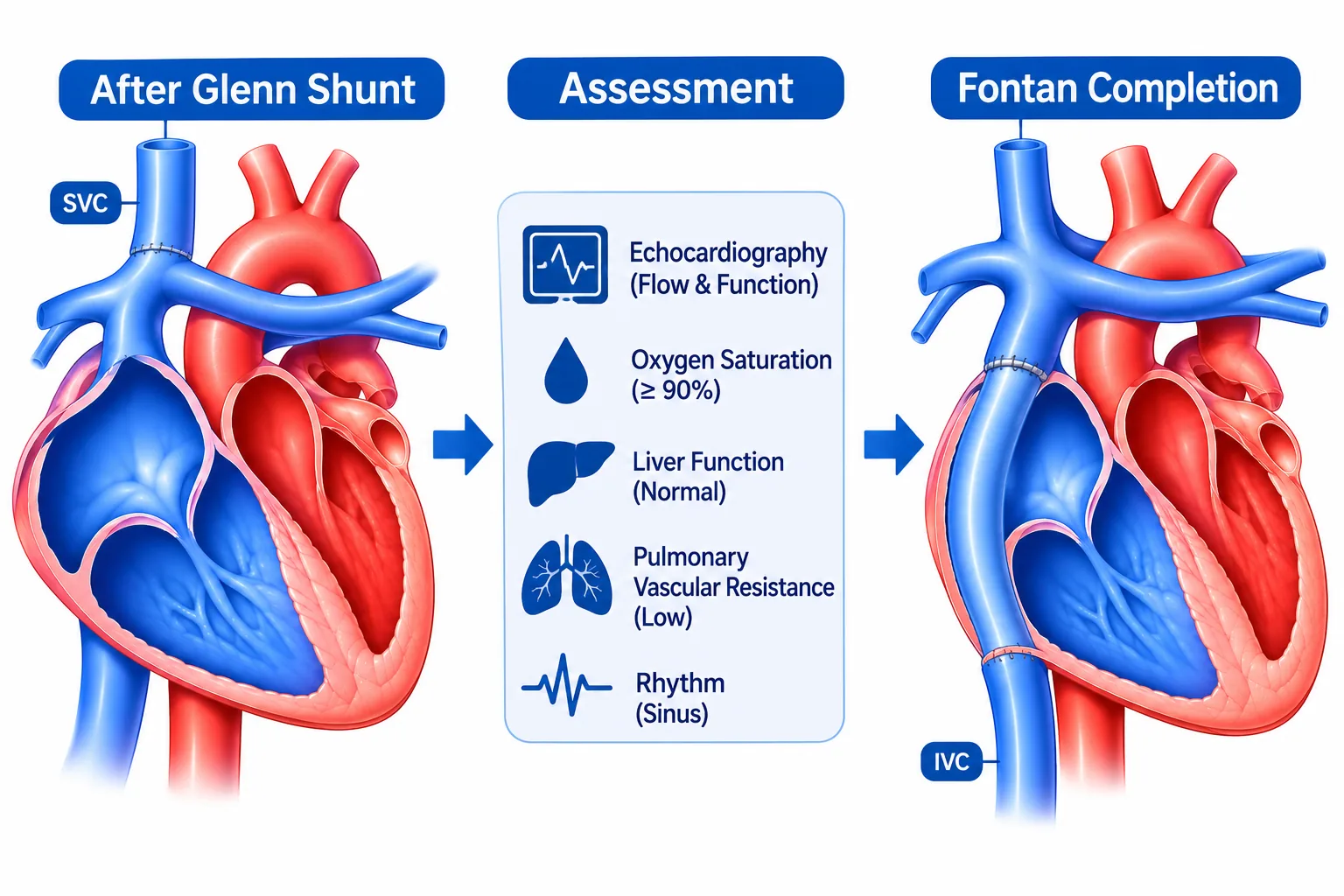
Children born with a single functioning pumping chamber — such as tricuspid atresia, hypoplastic heart or certain complex defects — are treated with staged operations. The Glenn operation connects the upper body veins directly to the lung arteries. The final stage, the Fontan operation, redirects blood from the lower body to the lungs as well.
The Fontan circulation works without a pump to push blood through the lungs, so it succeeds only when lung pressures are low, the pulmonary arteries are well grown and the heart is working well. A post-Glenn catheterisation checks all of these factors and treats problems that could compromise the Fontan.
Pressure Check
Glenn and pulmonary artery pressures and ventricular filling pressure are measured directly.
Anatomy Review
Pulmonary artery size, narrowings and the aortic arch are assessed by angiography.
Collateral Control
Unwanted collateral vessels can be closed with coils or plugs during the same procedure.
When Is It Recommended?
This assessment is typically performed:
- Before planning the Fontan operation after a Glenn shunt
- When oxygen saturations are falling after the Glenn
- If echo or MRI suggests pulmonary artery narrowing
- To look for decompressing venous or aortopulmonary collaterals
Not sure if your child needs this?
Share your child's reports and Dr. Bharath's team will guide you on the next step.
Conditions Covered
Heart conditions commonly assessed or treated with this service.
Tricuspid Atresia
A classic single-ventricle condition managed with Glenn and Fontan.
Hypoplastic Heart Syndromes
Underdeveloped left or right heart treated with staged palliation.
Double Inlet Ventricle
Both atria draining into one dominant ventricle.
Unbalanced AVSD
Atrioventricular septal defects unsuitable for two-ventricle repair.
Pulmonary Atresia with Intact Septum
Selected cases with a small right ventricle requiring the Fontan route.
Heterotaxy Syndromes
Complex arrangements of the heart and venous connections.
How It Is Performed
What happens on the day, explained simply so you know what to expect.
- 1Step 01 / 05
Planning
Review of operative notes, echo and saturation trends with the surgical team.
- 2Step 02 / 05
Venous & Arterial Access
Under anaesthesia, access is obtained in the groin and sometimes the neck.
- 3Step 03 / 05
Haemodynamic Study
Glenn, pulmonary artery and ventricular pressures and saturations are recorded.
- 4Step 04 / 05
Angiography
Pulmonary arteries, collaterals, aortic arch and ventricle are imaged.
- 5Step 05 / 05
Intervention if Needed
Narrowed arteries can be ballooned or stented and collaterals closed with coils or plugs.
Benefits, Risks & Care
A balanced overview, plus how to prepare and what recovery looks like.
Key Benefits
- Identifies children ready for a successful Fontan
- Problems are treated before surgery, not after
- Reduces risk of complications after Fontan
- Guides the surgical team's operative plan
Every child is different. Specific risks, benefits and alternatives for your child are discussed in detail during consultation.
Why Families Choose Dr. Bharath A. P.
Super-speciality training, academic experience and hands-on cath lab expertise.
National Board super-speciality fellowship at Madras Medical Mission Hospital, Chennai.
Assistant Professor of Pediatric Cardiology at Sri Jayadeva Institute of Cardiovascular Sciences and Research since 2015.
Diagnostic catheterisation and interventions including ASD, VSD and PDA closures, valvuloplasties and stenting.
Co-author of peer-reviewed articles in Heart Lung Circulation, Archives of Disease in Childhood and Annals of Pediatric Cardiology.
Frequently Asked Questions
Answers to common questions about Post-Glenn Assessment for Fontan Completion.
Is a catheter study always needed before the Fontan?
+
In most centres, yes. Direct pressure measurement remains the most reliable way to confirm that the lung circulation can support a Fontan. Some details may also be supplemented with MRI or CT.
What happens if the pressures are too high?
+
The cause is looked for and treated where possible — for example, opening narrowed arteries or closing collaterals. Medicines may be used and the Fontan timing adjusted until the circulation is ready.
Why close collateral vessels?
+
After the Glenn, extra vessels can develop that steal blood away from the lungs or overload them. Closing the problematic ones can improve oxygen levels and the outcome of the Fontan.
When is the Fontan usually done?
+
Typically between 2 and 5 years of age, depending on the child's growth, oxygen levels and catheter findings. The decision is made jointly with the cardiac surgeon.
Can MRI replace the catheter study?
+
MRI provides excellent pictures of the anatomy and flow, and is sometimes used alongside catheterisation. However, direct pressure measurement by catheter remains the most reliable way to confirm readiness for the Fontan.
What happens after a successful Fontan?
+
Most children have improved oxygen levels and can attend school and play normally. Lifelong follow-up with a pediatric cardiologist is needed to monitor heart and liver health.
Visit the Clinic
VEGA CURRE Multispeciality Clinic
2nd Floor, Shop No. 24 & 25, 3rd A Cross, Bhuvaneshwari Nagar, Dasarahalli Main Road, Hebbal Kempapura, Bengaluru – 560024