Balloon Aortic Valvuloplasty (BAV) in Bengaluru
Widening a narrowed aortic valve with a carefully sized balloon to relieve the strain on the heart — without open-heart surgery. Under the care of Dr. Bharath A. P.
- Newborns to Adolescents
- Relieves Valve Obstruction
- Avoids Early Surgery
- Echo-Guided Balloon Sizing

Dr. Bharath A. P.
Pediatric Interventional Cardiologist
Clinical Practice
Dedicated to newborn & child cardiac excellence
Children Evaluated
Evaluated with echocardiogram, from preterm infants to young adults
Children Operated
Cardiac interventions & cath lab procedures in children
Surgeries Coordinated
Coordinated surgical care for children with congenital heart diseases.
What Is Balloon Aortic Valvuloplasty?
Aortic valve stenosis is a narrowing of the valve through which the heart pumps blood to the body. The left ventricle has to work much harder, and over time it thickens and may weaken. In newborns, severe (critical) aortic stenosis can be life-threatening and needs urgent treatment.
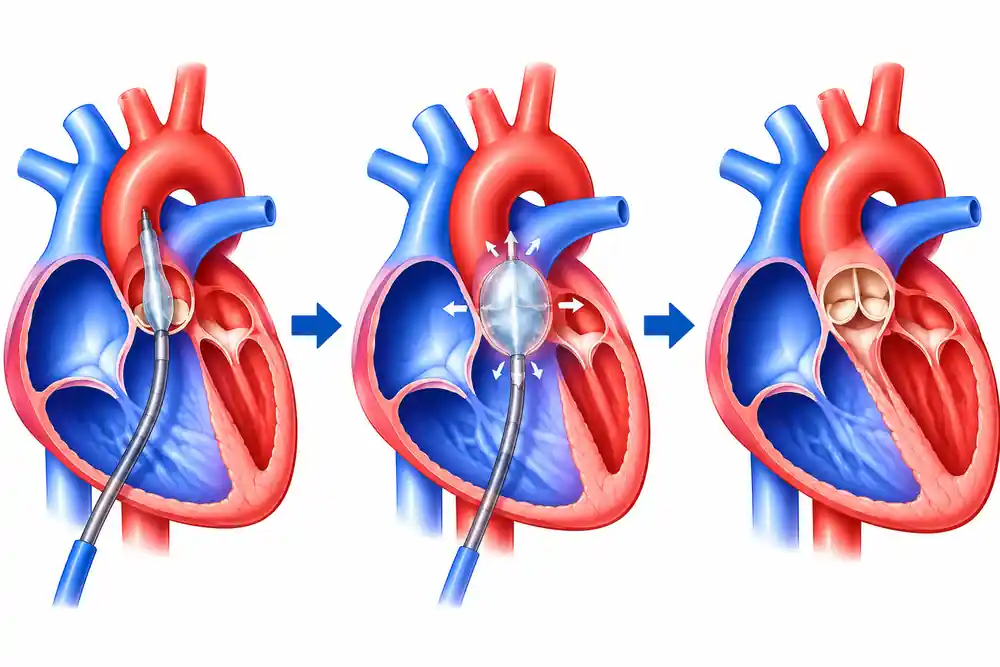
In balloon aortic valvuloplasty, a balloon catheter is passed from the groin artery to the valve and briefly inflated to open the fused valve leaflets. The balloon size is chosen carefully to relieve the narrowing while limiting valve leakage. BAV often postpones surgery for many years.
Careful Sizing
Balloon size is matched to the valve annulus to balance relief and leakage.
Neonatal Care
Critical aortic stenosis in newborns can be treated urgently in the cath lab.
Long-Term Plan
Regular follow-up tracks the valve, as further treatment may be needed later.
When Is It Recommended?
BAV may be recommended when:
- A newborn has critical aortic stenosis
- Echo or catheter shows a significant pressure gradient across the valve
- The child has chest pain, fainting or breathlessness on exertion
- ECG shows strain of the left ventricle
Not sure if your child needs this?
Share your child's reports and Dr. Bharath's team will guide you on the next step.
Conditions Covered
Heart conditions commonly assessed or treated with this service.
Critical Neonatal AS
Severe narrowing presenting soon after birth.
Congenital Valvar AS
Narrowing of the valve leaflets in infants and children.
Bicuspid Aortic Valve
Two-leaflet valves with significant stenosis.
Recurrent Stenosis
Re-narrowing after a previous balloon procedure.
How It Is Performed
What happens on the day, explained simply so you know what to expect.
- 1Step 01 / 05
Anaesthesia
Under anaesthesia, heart rhythm and blood pressure are watched closely, as the balloon briefly interrupts blood flow from the heart.
- 2Step 02 / 05
Arterial Access
A catheter is introduced through the groin artery (other routes in newborns).
- 3Step 03 / 05
Measurements
Pressure gradient and valve size are measured.
- 4Step 04 / 05
Balloon Dilatation
The balloon is positioned across the valve and inflated briefly.
- 5Step 05 / 05
Reassessment
The gradient and any valve leakage are rechecked before finishing.
Benefits, Risks & Care
A balanced overview, plus how to prepare and what recovery looks like.
Key Benefits
- Avoids or delays open-heart surgery
- Immediate relief of valve obstruction
- Short hospital stay in older children
- Can be repeated if needed
Every child is different. Specific risks, benefits and alternatives for your child are discussed in detail during consultation.
Why Families Choose Dr. Bharath A. P.
Super-speciality training, academic experience and hands-on cath lab expertise.
National Board super-speciality fellowship at Madras Medical Mission Hospital, Chennai.
Assistant Professor of Pediatric Cardiology at Sri Jayadeva Institute of Cardiovascular Sciences and Research since 2015.
Diagnostic catheterisation and interventions including ASD, VSD and PDA closures, valvuloplasties and stenting.
Co-author of peer-reviewed articles in Heart Lung Circulation, Archives of Disease in Childhood and Annals of Pediatric Cardiology.
Frequently Asked Questions
Answers to common questions about Balloon Aortic Valvuloplasty (BAV).
Is balloon valvuloplasty a permanent cure?
+
BAV relieves the narrowing, often for many years, but the aortic valve remains abnormal. Some children need a repeat balloon or valve surgery later in life, which is why regular follow-up is essential.
Why not do surgery straight away?
+
Balloon treatment avoids open-heart surgery in childhood and allows the child to grow. When surgery is eventually needed, it can often be done at an older age with better options.
Can my child play sports after BAV?
+
Activity advice depends on the remaining narrowing and any leakage. Dr. Bharath will give specific guidance after the follow-up echo.
How is critical aortic stenosis treated in newborns?
+
Newborns with critical aortic stenosis are stabilised and undergo urgent balloon valvuloplasty, which can be life-saving.
How long does it take to recover after BAV?
+
Older children usually go home within one or two days and return to school within a week. Newborns treated for critical stenosis may need a longer hospital stay.
Will my child need a valve replacement in future?
+
Some children do, often many years later. Regular echo follow-up shows when further treatment is needed, so it can be planned at the best time.
Visit the Clinic
VEGA CURRE Multispeciality Clinic
2nd Floor, Shop No. 24 & 25, 3rd A Cross, Bhuvaneshwari Nagar, Dasarahalli Main Road, Hebbal Kempapura, Bengaluru – 560024