
PDA Device & Coil Closure in Bengaluru
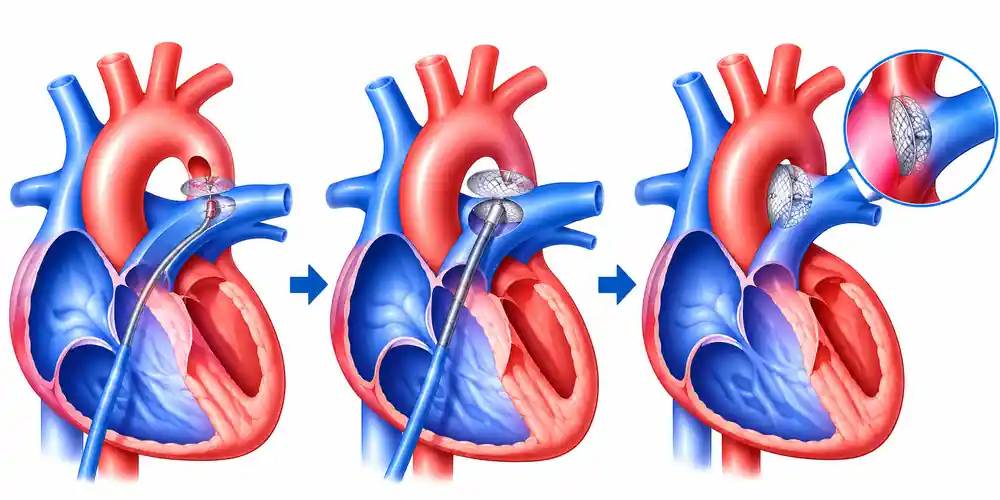
Sealing the open fetal blood vessel between the aorta and the lung artery with a duct occluder device or coil — through a small puncture in the groin. Under the care of Dr. Bharath A. P.
- Device or Coil Options
- Suitable for Infants & Children
- No Chest Surgery
- Usually Home Next Day

Dr. Bharath A. P.
Pediatric Interventional Cardiologist
Clinical Practice
Dedicated to newborn & child cardiac excellence
Children Evaluated
Evaluated with echocardiogram, from preterm infants to young adults
Children Operated
Cardiac interventions & cath lab procedures in children
Surgeries Coordinated
Coordinated surgical care for children with congenital heart diseases.
What Is PDA Device and Coil Closure?
Before birth, a blood vessel called the ductus arteriosus lets blood bypass the baby's lungs. It normally closes within a few days of birth. When it stays open — a patent ductus arteriosus (PDA) — extra blood flows into the lungs, which can cause fast breathing, poor feeding, poor weight gain and, over time, heart enlargement or pulmonary hypertension.
Most PDAs in infants and children can be closed through a catheter. Depending on the size and shape of the duct, a duct occluder device or a small coil is placed inside it from the groin, permanently stopping the abnormal flow. Dr. Bharath has co-authored published research comparing duct occluder designs and device size selection.
Tailored Choice
Duct shape and size on angiography determine whether a device or coil is best.
Immediate Result
Closure is confirmed on angiography and echo before the procedure ends.
Evidence-Based
Device selection is guided by published experience with different occluder designs.
When Is It Recommended?
PDA closure is recommended when:
- The PDA causes left heart enlargement
- The baby has breathlessness, sweating or poor weight gain
- There are recurrent chest infections
- A continuous murmur is present beyond infancy
Not sure if your child needs this?
Share your child's reports and Dr. Bharath's team will guide you on the next step.
Conditions Covered
Heart conditions commonly assessed or treated with this service.
Small PDA
Often suitable for coil closure.
Moderate to Large PDA
Closed with duct occluder devices of the appropriate design.
PDA in Infants
Selected small babies with symptomatic ducts.
PDA with Pulmonary Hypertension
Assessed carefully for operability before closure.
How It Is Performed
What happens on the day, explained simply so you know what to expect.
- 1Step 01 / 05
Anaesthesia
Depending on age, your child is given deep sedation or general anaesthesia; small babies are kept warm and closely watched.
- 2Step 02 / 05
Access
A small sheath is placed in the groin vein and, often, the artery.
- 3Step 03 / 05
Angiography
Contrast pictures show the size and shape of the duct.
- 4Step 04 / 05
Device or Coil
The chosen device or coil is positioned inside the duct and released once secure.
- 5Step 05 / 05
Confirmation
A final angiogram and echo confirm complete closure.
Benefits, Risks & Care
A balanced overview, plus how to prepare and what recovery looks like.
Key Benefits
- No chest surgery or scar
- Usually discharged the next day
- Symptoms and weight gain often improve quickly
- Permanent closure in most children
Every child is different. Specific risks, benefits and alternatives for your child are discussed in detail during consultation.
Why Families Choose Dr. Bharath A. P.
Super-speciality training, academic experience and hands-on cath lab expertise.
National Board super-speciality fellowship at Madras Medical Mission Hospital, Chennai.
Assistant Professor of Pediatric Cardiology at Sri Jayadeva Institute of Cardiovascular Sciences and Research since 2015.
Diagnostic catheterisation and interventions including ASD, VSD and PDA closures, valvuloplasties and stenting.
Co-author of peer-reviewed articles in Heart Lung Circulation, Archives of Disease in Childhood and Annals of Pediatric Cardiology.
Frequently Asked Questions
Answers to common questions about Patent Ductus Arteriosus (PDA) Device and Coil Closure.
Does every PDA need to be closed?
+
No. A very small 'silent' PDA that causes no murmur and no heart enlargement usually does not need closure. Closure is advised when the duct is significant or audible.
What is the difference between a coil and a device?
+
Coils are used for small ducts, while duct occluder devices are used for moderate and large ducts. The choice depends on the duct's size and shape on angiography.
Can PDA closure be done in babies?
+
Yes, in many cases. Device closure can be performed in infants once they reach a suitable size, and the choice between catheter closure and surgery is individualised.
Is the closure permanent?
+
Yes. Once the device or coil is in place, tissue grows over it and the duct remains closed for life.
Is PDA closure safe in premature babies?
+
Very small or premature babies are first managed with medicines or careful observation. Catheter closure is considered once the baby reaches a suitable size, and the choice is individualised with the neonatal team.
Will my child need any medicines after PDA closure?
+
Usually no long-term medicines are needed. Antibiotic cover for dental procedures may be advised for a few months after the device is placed.
Visit the Clinic
VEGA CURRE Multispeciality Clinic
2nd Floor, Shop No. 24 & 25, 3rd A Cross, Bhuvaneshwari Nagar, Dasarahalli Main Road, Hebbal Kempapura, Bengaluru – 560024