
Balloon Pulmonary Valvuloplasty (BPV) in Bengaluru
The treatment of choice for pulmonary valve stenosis — a balloon opens the narrowed valve through a vein in the groin, with excellent long-term results. Under the care of Dr. Bharath A. P.
- Treatment of Choice for PS
- Excellent Long-Term Results
- Suitable for Newborns
- Usually Home Next Day

Dr. Bharath A. P.
Pediatric Interventional Cardiologist
Clinical Practice
Dedicated to newborn & child cardiac excellence
Children Evaluated
Evaluated with echocardiogram, from preterm infants to young adults
Children Operated
Cardiac interventions & cath lab procedures in children
Surgeries Coordinated
Coordinated surgical care for children with congenital heart diseases.
What Is Balloon Pulmonary Valvuloplasty?
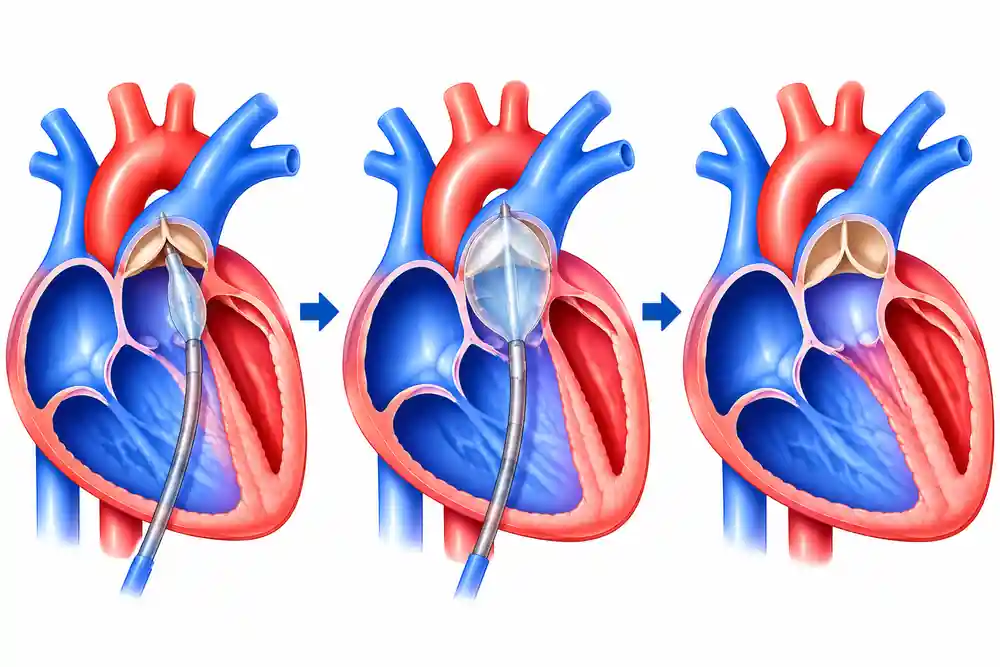
Pulmonary valve stenosis is a narrowing of the valve between the right ventricle and the lung artery. Mild narrowing needs only observation, but moderate or severe stenosis makes the right ventricle work harder and, in newborns, critical stenosis can cause low oxygen levels.
In balloon pulmonary valvuloplasty, a balloon catheter is passed from a groin vein into the narrowed valve and inflated for a few seconds to open the fused leaflets. For typical pulmonary valve stenosis, this is the treatment of choice and usually provides lasting relief without surgery.
Highly Effective
Most children with typical valvar stenosis need no further treatment.
Venous Approach
Performed entirely through a vein, avoiding the groin artery.
Newborn Ready
Critical pulmonary stenosis in newborns can be treated in the cath lab.
When Is It Recommended?
BPV is recommended when:
- Echo shows moderate or severe pulmonary valve stenosis
- A newborn has critical pulmonary stenosis with low oxygen levels
- The right ventricle is thickened or under strain
- The child has breathlessness or fatigue on exertion
Not sure if your child needs this?
Share your child's reports and Dr. Bharath's team will guide you on the next step.
Conditions Covered
Heart conditions commonly assessed or treated with this service.
Typical Valvar PS
Dome-shaped, fused valve — responds very well to balloon dilatation.
Critical Neonatal PS
Severe narrowing in newborns needing prompt treatment.
Dysplastic Pulmonary Valve
Thickened valves (e.g., in Noonan syndrome) with variable response.
Selected Tetralogy of Fallot
Palliative dilatation in specific cases before surgical repair.
How It Is Performed
What happens on the day, explained simply so you know what to expect.
- 1Step 01 / 05
Anaesthesia
Your child sleeps comfortably under sedation; newborns may come directly from the NICU with supportive care in place.
- 2Step 02 / 05
Vein Access
A small sheath is placed in the groin vein.
- 3Step 03 / 05
Measurement
Right ventricular pressure and valve size are measured with angiography.
- 4Step 04 / 05
Balloon Inflation
A balloon is positioned across the valve and inflated briefly.
- 5Step 05 / 05
Confirmation
Pressures are rechecked to confirm successful relief.
Benefits, Risks & Care
A balanced overview, plus how to prepare and what recovery looks like.
Key Benefits
- Avoids open-heart surgery
- Excellent and durable results in typical PS
- Short hospital stay
- Rapid return to normal activity
Every child is different. Specific risks, benefits and alternatives for your child are discussed in detail during consultation.
Why Families Choose Dr. Bharath A. P.
Super-speciality training, academic experience and hands-on cath lab expertise.
National Board super-speciality fellowship at Madras Medical Mission Hospital, Chennai.
Assistant Professor of Pediatric Cardiology at Sri Jayadeva Institute of Cardiovascular Sciences and Research since 2015.
Diagnostic catheterisation and interventions including ASD, VSD and PDA closures, valvuloplasties and stenting.
Co-author of peer-reviewed articles in Heart Lung Circulation, Archives of Disease in Childhood and Annals of Pediatric Cardiology.
Frequently Asked Questions
Answers to common questions about Balloon Pulmonary Valvuloplasty (BPV).
How successful is balloon pulmonary valvuloplasty?
+
For typical pulmonary valve stenosis, BPV is very successful, and most children do not need further treatment. Dysplastic valves may respond less well and are assessed individually.
Does mild pulmonary stenosis need treatment?
+
No. Mild stenosis usually stays mild and only needs periodic check-ups.
Will the valve leak after the balloon?
+
Some mild leakage is common but usually well tolerated. It is monitored during follow-up.
Can newborns undergo BPV?
+
Yes. Newborns with critical pulmonary stenosis are treated with balloon valvuloplasty, often within the first days of life.
How soon can my child return to normal activities?
+
Most children are back to school and normal play within a few days. Dr. Bharath will confirm any activity advice after the follow-up echo.
Does pulmonary stenosis run in families?
+
Most cases occur by chance, but it can be associated with certain genetic conditions such as Noonan syndrome. Dr. Bharath may suggest a genetic evaluation in specific cases.
Visit the Clinic
VEGA CURRE Multispeciality Clinic
2nd Floor, Shop No. 24 & 25, 3rd A Cross, Bhuvaneshwari Nagar, Dasarahalli Main Road, Hebbal Kempapura, Bengaluru – 560024