
MAPCA Stenting in Bengaluru
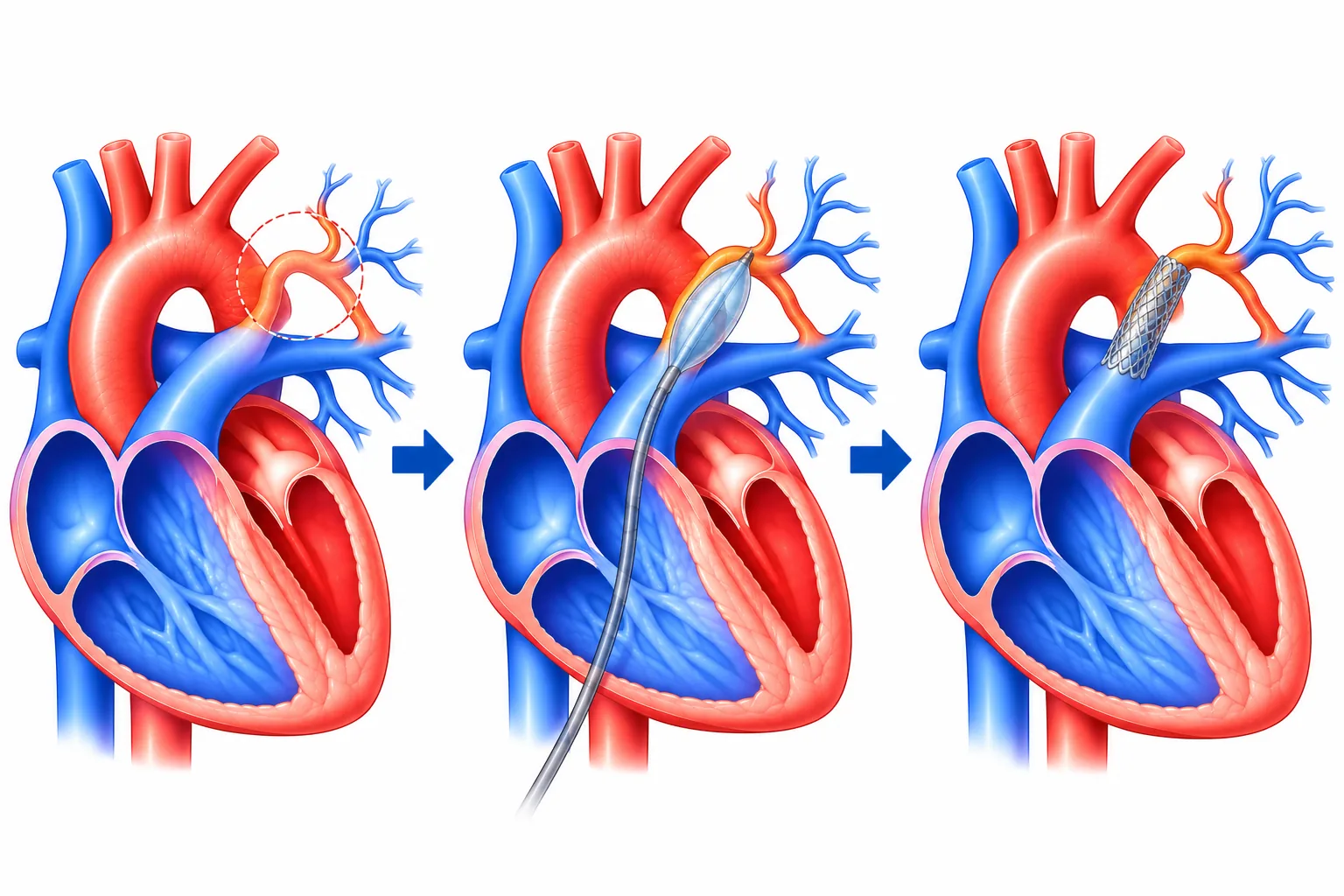
Opening narrowed collateral arteries that supply the lungs in complex pulmonary atresia, improving oxygen levels and preparing the circulation for surgery. Under the care of Dr. Bharath A. P.
- Complex Pulmonary Atresia Care
- Improves Oxygen Saturation
- Prepares for Surgical Repair
- Team-Based Planning

Dr. Bharath A. P.
Pediatric Interventional Cardiologist
Clinical Practice
Dedicated to newborn & child cardiac excellence
Children Evaluated
Evaluated with echocardiogram, from preterm infants to young adults
Children Operated
Cardiac interventions & cath lab procedures in children
Surgeries Coordinated
Coordinated surgical care for children with congenital heart diseases.
What Are MAPCAs?
In some babies with pulmonary atresia and VSD, the normal connection from the heart to the lungs is absent. Instead, blood reaches the lungs through major aortopulmonary collateral arteries (MAPCAs) — abnormal vessels arising from the aorta. These vessels often develop narrowings that reduce lung blood flow and lower oxygen levels.
Stenting a narrowed MAPCA restores flow to the lung segments it supplies, improving oxygen saturation and helping the lung arteries grow. This is part of a carefully staged, team-based plan with the cardiac surgeons, leading towards surgical unifocalisation and repair.
Detailed Mapping
Each collateral and the lung segments it supplies are defined by angiography.
Targeted Stenting
Only collaterals that are narrowed and important for lung supply are treated.
Surgical Partnership
Every decision is coordinated with the surgical team towards complete repair.
When Is It Recommended?
MAPCA stenting may be considered when:
- Oxygen saturations are low because of narrowed collaterals
- Important lung segments are under-supplied
- The child needs bridging until surgical repair
- Collaterals narrow again after previous procedures
Not sure if your child needs this?
Share your child's reports and Dr. Bharath's team will guide you on the next step.
Conditions Covered
Heart conditions commonly assessed or treated with this service.
Pulmonary Atresia with VSD & MAPCAs
The primary condition requiring collateral assessment and treatment.
Complex Tetralogy of Fallot
Severe forms with collateral-dependent lung blood supply.
Post-Unifocalisation Stenosis
Narrowing after surgical rerouting of collaterals.
Single-Ventricle with MAPCAs
Selected complex hearts with collateral lung supply.
How It Is Performed
What happens on the day, explained simply so you know what to expect.
- 1Step 01 / 05
Imaging Review
Echo and CT angiography help plan the procedure.
- 2Step 02 / 05
Anaesthesia & Access
Under general anaesthesia, access is obtained via the groin artery.
- 3Step 03 / 05
Selective Angiography
Each collateral is mapped to identify narrowings.
- 4Step 04 / 05
Stent Placement
A stent is deployed in the narrowed collateral.
- 5Step 05 / 05
Saturation Check
Oxygen levels and flow are reassessed before completion.
Benefits, Risks & Care
A balanced overview, plus how to prepare and what recovery looks like.
Key Benefits
- Improved oxygen saturation
- Better blood supply to lung segments
- Helps lung arteries grow before surgery
- Can avoid or delay high-risk surgery
Every child is different. Specific risks, benefits and alternatives for your child are discussed in detail during consultation.
Why Families Choose Dr. Bharath A. P.
Super-speciality training, academic experience and hands-on cath lab expertise.
National Board super-speciality fellowship at Madras Medical Mission Hospital, Chennai.
Assistant Professor of Pediatric Cardiology at Sri Jayadeva Institute of Cardiovascular Sciences and Research since 2015.
Diagnostic catheterisation and interventions including ASD, VSD and PDA closures, valvuloplasties and stenting.
Co-author of peer-reviewed articles in Heart Lung Circulation, Archives of Disease in Childhood and Annals of Pediatric Cardiology.
Frequently Asked Questions
Answers to common questions about Major Aortopulmonary Collateral Artery (MAPCA) Stenting.
Why does my child have MAPCAs?
+
MAPCAs develop when the normal pulmonary artery does not form properly before birth. They act as an alternative blood supply to the lungs.
Is MAPCA stenting a cure?
+
No. It is a step in a staged treatment plan that improves oxygen levels and lung artery growth before surgical repair.
How many procedures will my child need?
+
This varies. Many children need several catheter procedures and operations over time, planned jointly with the surgical team.
What is unifocalisation?
+
It is a surgery in which the collateral arteries are rerouted to form a single pulmonary artery system, which can then be connected to the heart.
Will my child need surgery after MAPCA stenting?
+
In most cases, yes. Stenting improves blood flow and lung artery growth so that surgical repair can be performed more safely later.
What follow-up is needed after MAPCA stenting?
+
Regular monitoring of oxygen levels, echo and periodic CT or catheter studies are needed, along with antiplatelet medicine as advised, until the planned surgical repair.
Visit the Clinic
VEGA CURRE Multispeciality Clinic
2nd Floor, Shop No. 24 & 25, 3rd A Cross, Bhuvaneshwari Nagar, Dasarahalli Main Road, Hebbal Kempapura, Bengaluru – 560024