
Pulmonary Artery Stenting in Bengaluru
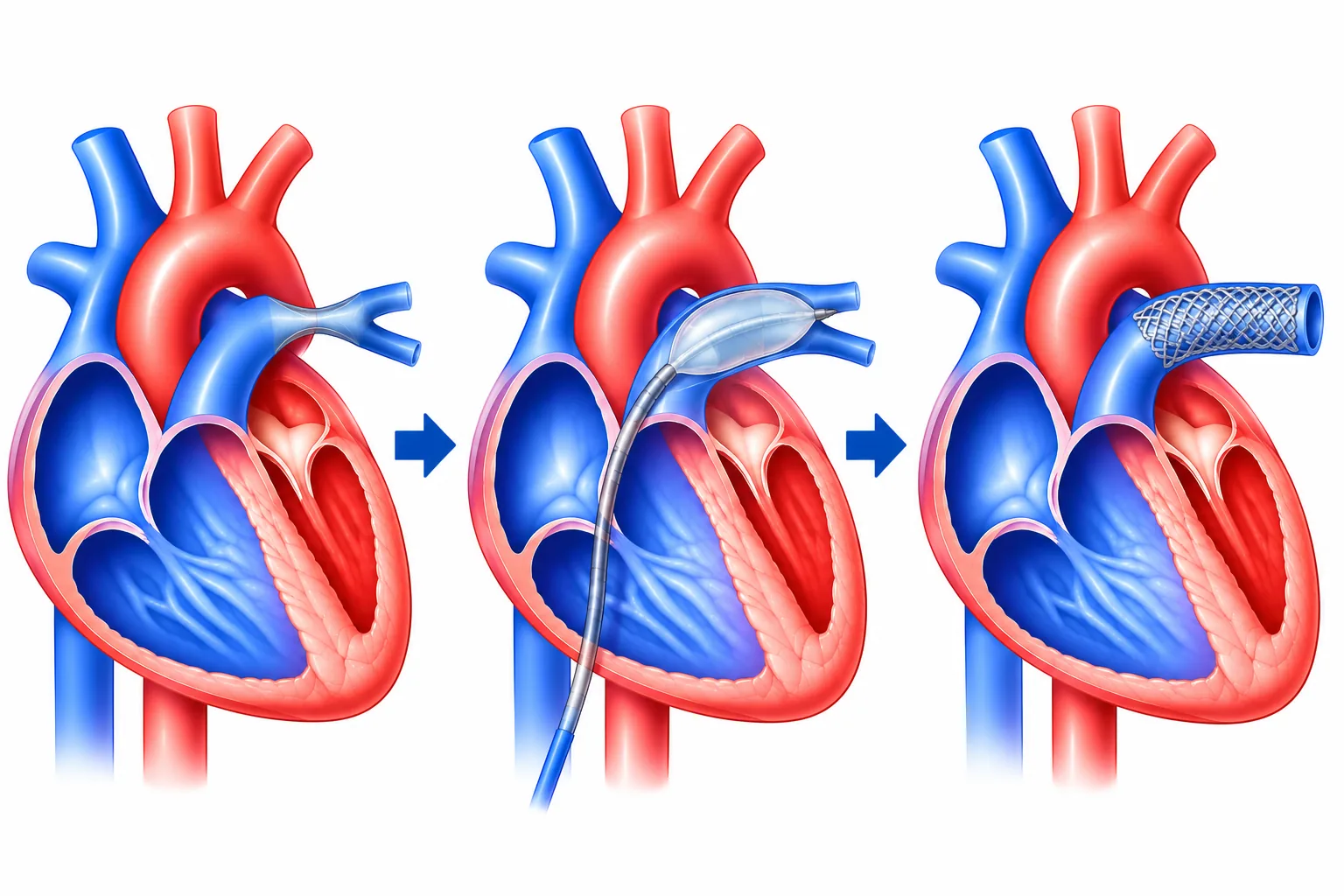
Placing a stent to open narrowed lung arteries, improving blood flow to the lungs and reducing pressure on the right side of the heart. Under the care of Dr. Bharath A. P.
- Branch PA Stenosis Treatment
- Post-Surgical Narrowings
- Redilatable as Child Grows
- Avoids Repeat Surgery

Dr. Bharath A. P.
Pediatric Interventional Cardiologist
Clinical Practice
Dedicated to newborn & child cardiac excellence
Children Evaluated
Evaluated with echocardiogram, from preterm infants to young adults
Children Operated
Cardiac interventions & cath lab procedures in children
Surgeries Coordinated
Coordinated surgical care for children with congenital heart diseases.
What Is Pulmonary Artery Stenting?
The pulmonary arteries carry blood from the heart to the lungs. They can be narrowed from birth, as part of certain genetic syndromes, or after heart surgery such as Tetralogy of Fallot repair, the arterial switch or the Glenn operation. Narrowing reduces blood flow to part of the lung and increases pressure in the right ventricle.
Balloons alone often fail because the artery wall recoils. A stent — a metal mesh tube mounted on a balloon — is expanded inside the narrowed segment to hold it open. Stents can be redilated later as the child grows, often avoiding the need for further surgery.
Better Lung Perfusion
Restores balanced blood flow to both lungs.
Right Heart Relief
Reduces pressure and strain on the right ventricle.
Future-Proof
Stents can be expanded further during later catheter procedures.
When Is It Recommended?
Pulmonary artery stenting may be recommended when:
- A branch pulmonary artery is significantly narrowed
- Lung scans or MRI show reduced flow to one lung
- Right ventricular pressure is raised
- Narrowing develops after Tetralogy of Fallot repair or other surgery
Not sure if your child needs this?
Share your child's reports and Dr. Bharath's team will guide you on the next step.
Conditions Covered
Heart conditions commonly assessed or treated with this service.
Post-Operative PA Stenosis
After Tetralogy of Fallot repair, arterial switch or shunt surgery.
Single-Ventricle Circulation
Narrowing in Glenn or Fontan pathways.
Syndromic PA Stenosis
Associated with Williams or Alagille syndrome.
Congenital Branch Stenosis
Narrowing present from birth.
How It Is Performed
What happens on the day, explained simply so you know what to expect.
- 1Step 01 / 05
Anaesthesia
Under general anaesthesia, oxygen levels and breathing are watched closely, as blood flow to the lungs is being treated.
- 2Step 02 / 05
Vein Access
Catheters are introduced through the groin vein.
- 3Step 03 / 05
Angiography
The narrowed segment is measured precisely.
- 4Step 04 / 05
Stent Deployment
A balloon-mounted stent is expanded within the narrowing.
- 5Step 05 / 05
Result Check
Pressure and angiography confirm improved flow.
Benefits, Risks & Care
A balanced overview, plus how to prepare and what recovery looks like.
Key Benefits
- Avoids repeat open-heart surgery
- Immediate improvement in lung blood flow
- Lower right heart pressure
- Stent can be enlarged as the child grows
Every child is different. Specific risks, benefits and alternatives for your child are discussed in detail during consultation.
Why Families Choose Dr. Bharath A. P.
Super-speciality training, academic experience and hands-on cath lab expertise.
National Board super-speciality fellowship at Madras Medical Mission Hospital, Chennai.
Assistant Professor of Pediatric Cardiology at Sri Jayadeva Institute of Cardiovascular Sciences and Research since 2015.
Diagnostic catheterisation and interventions including ASD, VSD and PDA closures, valvuloplasties and stenting.
Co-author of peer-reviewed articles in Heart Lung Circulation, Archives of Disease in Childhood and Annals of Pediatric Cardiology.
Frequently Asked Questions
Answers to common questions about Pulmonary Artery Stenting.
Why use a stent instead of just a balloon?
+
Many pulmonary artery narrowings spring back after ballooning. A stent holds the vessel open, giving a more lasting result.
Will the stent limit growth of the artery?
+
Stents are chosen so that they can be expanded further during later catheter procedures, allowing the artery to keep pace with growth.
Can stenting be done after heart surgery?
+
Yes. Treating narrowings after surgery is one of the commonest reasons for pulmonary artery stenting, and it often avoids another operation.
How long will my child need medicines?
+
Antiplatelet medicine is usually given for a period after stenting. Dr. Bharath will advise the duration based on your child's condition.
Is the stent permanent?
+
Yes. The stent stays in place permanently and becomes covered by the vessel lining. It can be expanded further during later catheter procedures as your child grows.
What symptoms improve after stenting?
+
Children often have better exercise tolerance and, in some circulations, improved oxygen levels. Pressure on the right side of the heart also reduces, which protects heart function over time.
Visit the Clinic
VEGA CURRE Multispeciality Clinic
2nd Floor, Shop No. 24 & 25, 3rd A Cross, Bhuvaneshwari Nagar, Dasarahalli Main Road, Hebbal Kempapura, Bengaluru – 560024